
Press
A Brief History of Surfboards
From ancient Peruvian reed horses to computer-generated designs — how 5,000 years of innovation shaped the board beneath your feet.
Written by Tim Barlass
The date is about 3000 BC. The place, Peru. The key ingredients are totora reeds (a kind of giant bullrush), skill and courage. Bind the four-metre long reeds together and add a paddle, and you have a caballito de totora — or 'little reed horse' — a floating board. You may well have the birth of wave riding, and a precursor to surfing.
“I'm a Huanchaco fisherman, like my ancestors. My caballito de totora is my boat that provides for my livelihood and family.”
Carlos "Huevito" Ucanan from Huanchaco, north of Lima in Peru, keeps the ancient tradition alive and has visited Australia to demonstrate the construction and his skills on the caballito at Noosa. Fast forward 3,300 years to 300 AD: in Polynesia, solid wood boards are now the wave vehicle of choice. Surfing has arrived.


In the centuries before the arrival of Captain Cook in Hawaii, surfing was at the core of island culture. According to The Art of the Surfboard by Greg Noll, an American pioneer of big wave surfing, the status of an individual dictated what type of board they could use: short and wide for commoners, and long 18ft (5.5m) and narrow for the chiefs.
Various kinds of competition were staged when the surf was running. "The stakes could range from a pig to a wife, from a canoe to a man's life. Surfing was a joyful endeavour that could also turn deadly serious," writes Noll.
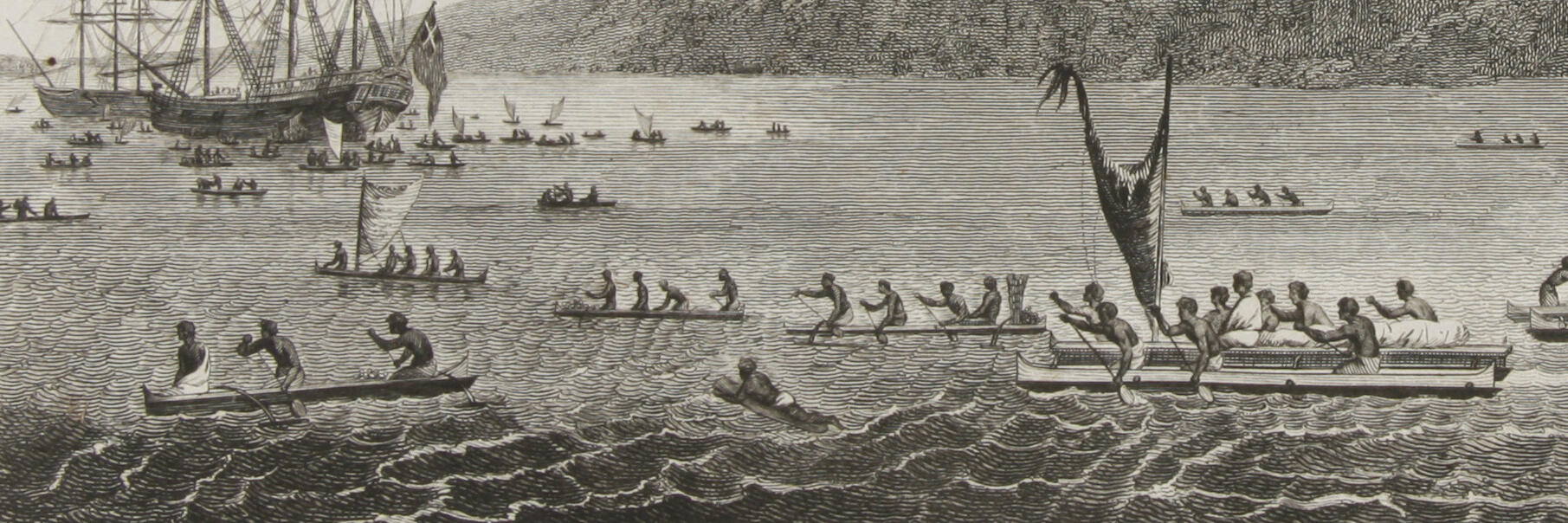
Captain Cook and surfing aren't normally synonymous, but a sketch of Karakakooa Bay in Hawaii by John Webber — the official artist on Cook's third voyage to the Pacific — has an interesting detail. It depicts islanders greeting Cook's ship HMS Resolution, and in the lower left centre of the picture is an early 'surfer' paddling out to meet the ship. After Cook was killed on Hawaii, First Lieutenant James King was assigned the task of continuing Cook's journal, providing the earliest written account of surfing.
“About 20 or 30 of the islanders take each a long narrow board, rounded at both ends, and set out from the shore in company with each other... The amazing courage and address, with which they perform these dangerous manoeuvres, are almost incredible.”

Though Australia was first introduced to surfing in the late 19th century by traders and travellers who had passed through Hawaii, the surfing demonstrations of Hawaiian Duke Kahanamoku in 1914–15 were a significant moment in Australia's surfing history. Solid hardwood planks were common on Australian beaches between World War I and World War II, and pre-dated the Australian surfing boom of the late 1950s and early 1960s.


The end of World War II opened up new possibilities in surfboard design. Many new materials had become available through advances in technology during the war. As a result, fiberglass-coated Malibus were developed in the late 1950s, allowing surfers a greater range of manoeuvres than early wooden boards. The Malibu shape was introduced to Australia in 1956 when a group of Californian lifeguards brought new Malibu boards. Australians began experimenting with balsa, foam-and-fiberglass designs, and eventually the Malibu went into mass-production.


Key Moments in Surfboard Design
- 1Fiberglass Outer Shells1940s – 1950s
The introduction of fiberglass resin laminates sealed foam cores, improving durability and allowing vibrant graphics — becoming a standard construction method.
- 2Foam-and-Fiberglass "Sandwich" Boards1950
Bob Simmons introduced the earliest foam-core boards (polystyrene) with fiberglass and balsa veneers, generating lighter, more maneuverable shapes.
- 3Polyurethane Foam Blanks1958 – 1961
Hobie Alter and Gordon "Grubby" Clark pioneered moulded polyurethane blanks in 1958, dominating the market until 2005.
- 4Shortboard Revolution & V-Bottom1960s – 1970s
The shift from longboards to performance-focused shortboards — with innovations like Bob McTavish's Vee-bottom — allowed sharper turns and greater responsiveness.
- 5Thruster Fin System1980
Simon Anderson's three-fin "thruster" design greatly enhanced maneuverability and became the industry-standard fin setup that most boards still use today.
- 6Modern Materials & Technology1990s – present
EPS foam with epoxy resins, carbon/Kevlar reinforcements, CNC shaping, vacuum bagging, computer-aided design, and sustainable materials now define surfboard manufacturing.
Originally published in
Australian National Maritime Museum
December 2025